Ekta Bagri Residency
05 | 10 | 2025
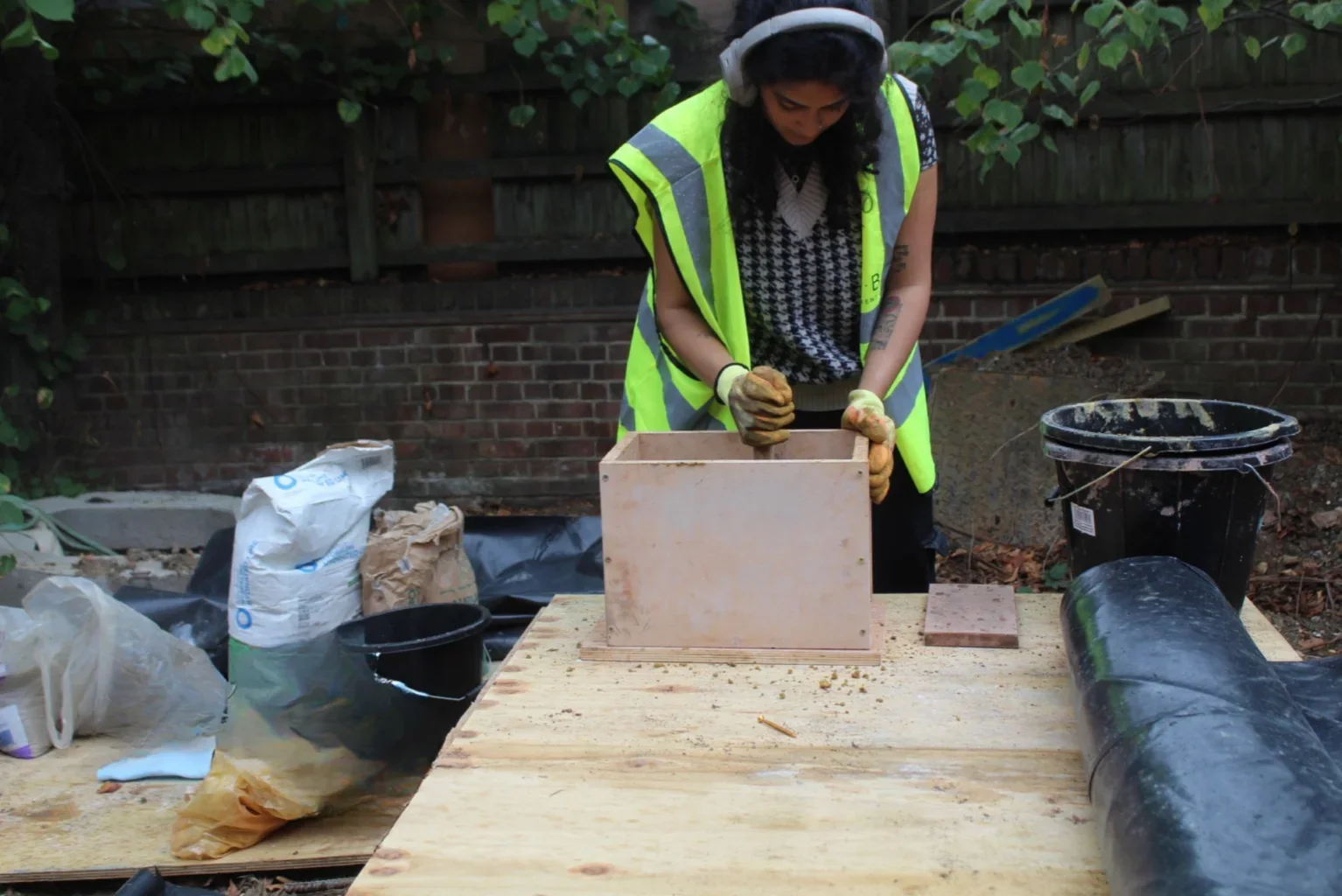
In October, Golden Earth Studio welcomed artist DPhil research Ekta Bagri to a construction site in Wimbledon, for a one-day, in situ residency.
Ekta produced a set of three rammed earth blocks for our exhibition ‘Reframing Waste’ in Covent Garden for London Design Festival 2025.
Golden Earth Studio interviewed Ekta to learn more about her practice and the philosophy behind her work.
Can you introduce yourself and your practice?
–
I’m Ekta, a DPhil researcher in Archaeology at the University of Oxford. My practice sits at the seam of making and archaeology: I learn through doing, working on sites, rebuilding kilns, preparing clay in situ, and reading surfaces as records of process. This hybrid approach, fieldwork, studio experiment, and clear documentation- shapes both my research and my making, from wood-firing traditions and kiln archaeology to public-facing displays and teaching.
What drew you to explore clay in your practice?
–
Clay holds touch. It remembers gestures, pressure, and the habits of hands, ours and those before us. I’m drawn to that memory and to provenance: where a material comes from, what it has weathered, and how its character emerges under care. Clay is malleable yet willful; it stretches under patient moulding and resists when rushed. Working with it is a conversation, one where the material’s own timing and breath matter as much as my intention.
Where do you find inspiration for rammed earth techniques and material compositions?
–
My research is rooted in materials and in the ethics of waste. I use unfired processes to foreground location, provenance, and the materiality of Earth, so that pieces can be made, deconstructed, and returned to the ground. Much of my raw material comes from waste soils, often wild-clay rich, diverted from construction sites. Rammed earth and bio-based binders (including bacteria-driven “bio-concrete”) help establish living conditions within a piece: moisture moves, clay breathes, salts bloom. The work is dialogic, formed through conversations with researchers, construction teams, gardeners, and local residents, so it can bridge human and non-human worlds and make space for an ecology of materials.
Had secondary resources played a role in your work before your collaboration with Golden Earth Studio? Why does engaging with by-products hold significance for you?
–
Yes. I’ve long worked with what’s at hand, offcuts, spoil, and by-products, because they carry site-specific stories and responsibilities. I align with care-based thinking (after Maria Puig de la Bellacasa): maintaining and repairing the world so that more than just “we” can live well. For me, using by-products tests what our environment could look like if we changed our defaults, valuing cyclical making over extractive novelty. It also widens authorship: material agencies (bacteria, minerals, moisture) become collaborators, not just “inputs.”
Can you outline what material you are working with from GES and how you transform it in your ceramic practice? What is the material like to work with?
–
From Golden Earth Developments (GES) I work with excavated subsoils and wild clays gathered directly from live or recent construction sites. On site, I assess grain size, plasticity, and moisture; then I sieve, temper, and compact the mixes in layers to ram blocks that can be functional or sculptural. The material is raw and honest, its behaviour depends on weather, water content, and how gently it’s compacted. Working where the soil emerges lets me keep provenance legible: you can read the section, the strata, and, later, the drying marks as part of the piece’s biography.
Can you give an outline of the in situ residency at Golden Earth Studio? What was the physical setup, and how did working on-site influence your practice?
–
I worked with GES at their Wimbledon project, producing rammed-earth blocks from excavated soils that would otherwise go to landfill. The setup was deliberately light and open: sieves, formwork, tampers, moisture tests, and curing racks right beside the dig. Making in situ sharpened the feedback loop, soil tests led directly to mix adjustments, and the pieces recorded that iteration. Rammed earth has been central to my practice since my RCA degree show (2023); its temporality is essential to me: because the clay isn’t fired, the blocks can be unmade and returned to the ground, completing the cycle.
How do you see your rammed-earth blocks integrating into and enhancing everyday living environments?
–
I design the blocks as adaptable, low-impact elements that slip into everyday life. They can act as partition walls, plinths, benches, joinery infills, adding mass without heavy finishes. Because the earth remains unfired, it moderates humidity and temperature and lends acoustic calm, qualities you sense rather than see. Surfaces invite maintenance rather than disposal: chips and edges can be re-rammed or skim-coated, and patina is welcomed as a record of use. As dry-assembled modules, the blocks can be reconfigured, crushed and re-compacted, keeping material cycling locally. In all of this, the aim is to let “waste” read as quietly beautiful and genuinely useful, objects that earn their place through care, material honesty and the possibility of return.